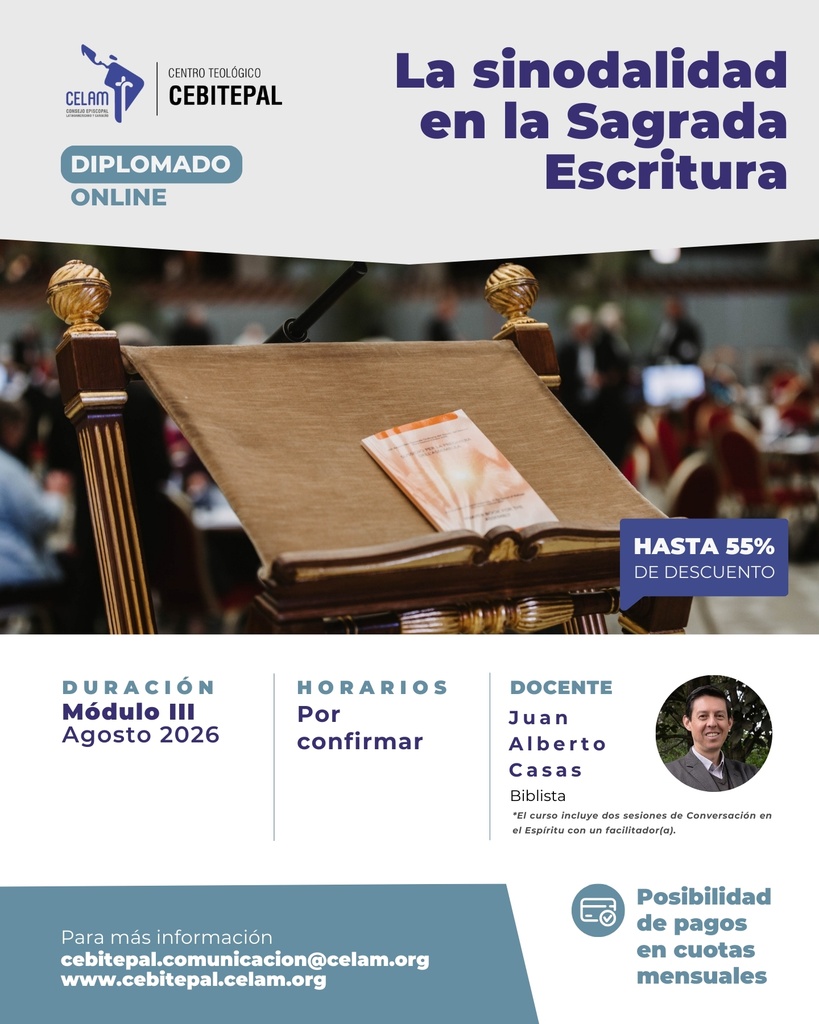
Synodality in Sacred Scripture – Module 3
| Profesor | Dr. Juan Alberto Casas Ramírez |
|---|---|
| Categoría | Virtual |
Description of the diploma
The diploma explores how synodality —more than a strategy for decision-making— constitutes the way of being and acting of the disciples of Jesus. Although the term does not appear explicitly in the Bible, its dynamics and practices have a profound biblical foundation. The proposal of Dr. Juan Alberto Casas traverses concepts and experiences that sustain the communal life of the People of God: listening (shemah), docility to the Spirit (Ruah), justice (tzedaká), communion (koinonía), the People of God (qahal) and the Kingdom of God (basileia tou Theou).
The program allows understanding how Scripture reveals the way God expects relationships within the People of God to be, illuminating the fraternal walk of the current Church.
Modality of the diploma
The diploma is offered in synchronous modality, with live classes via Zoom, and is organized into three modules according to the quarterly programming of CEBITEPAL.
- Each module has a duration of one month.
- Includes four synchronous classes taught by the professor.
- Includes a session of “Conversation in the Spirit” to deepen community engagement with the content.
In total, the diploma includes 12 synchronous classes and 3 sessions of Conversation in the Spirit, integrating biblical reflection and synodal practice.
Focus of the diploma
- Exegetical and theological analysis of biblical texts on synodality.
- Contextual and pastoral reading from Latin America.
- Methodologies of community hermeneutics and discernment.
- Bridges between Scripture, ecclesial tradition, and current challenges.
Main contents
- Biblical foundations: shemah, Ruah, prophecy and justice.
- Jesus and the Kingdom of God: praxis of Jesus and paths of discipleship.
- The emerging ecclesia: koinonia, charisms and community structures.
Horizon of the diploma
The diploma seeks to enable a biblical reading that illuminates current synodal life, strengthening listening, discernment, and shared mission in the communities. Its horizon is a Church that more fully lives its identity as People of God on the way.
Professor of the diploma
Juan Alberto Casas Ramírez
Professor of New Testament at the Pontifical Javeriana University (Bogotá, Colombia). He holds a doctorate and master's degree in Theology and a bachelor's degree in Religious Sciences. He has been a visiting professor at various universities, dioceses, spirituality institutes, seminaries, and theological training centers in Latin America and Europe. His areas of teaching, research, and publication include the synoptic tradition, the Fourth Gospel, the Apocalypse, Jewish and Christian apocryphal literature, and Biblical Hermeneutics in contexts of violence and conflict.
-
📘 Course Information6Lessons ·
-
📚 Clase 13Lessons ·
-
📚 Clase 23Lessons ·
-
📚 Clase 43Lessons ·
-
📚 Clase 33Lessons ·
-
🤝 Conversation in the spirit1Lessons ·
-
Course closure1Lessons ·
Lección no disponible
Description of the diploma
The diploma explores how synodality —more than a strategy for decision-making— constitutes the way of being and acting of the disciples of Jesus. Although the term does not appear explicitly in the Bible, its dynamics and practices have a profound biblical foundation. The proposal of Dr. Juan Alberto Casas traverses concepts and experiences that sustain the communal life of the People of God: listening (shemah), docility to the Spirit (Ruah), justice (tzedaká), communion (koinonía), the People of God (qahal) and the Kingdom of God (basileia tou Theou).
The program allows understanding how Scripture reveals the way God expects relationships within the People of God to be, illuminating the fraternal walk of the current Church.
Modality of the diploma
The diploma is offered in synchronous modality, with live classes via Zoom, and is organized into three modules according to the quarterly programming of CEBITEPAL.
- Each module has a duration of one month.
- Includes four synchronous classes taught by the professor.
- Includes a session of “Conversation in the Spirit” to deepen community engagement with the content.
In total, the diploma includes 12 synchronous classes and 3 sessions of Conversation in the Spirit, integrating biblical reflection and synodal practice.
Focus of the diploma
- Exegetical and theological analysis of biblical texts on synodality.
- Contextual and pastoral reading from Latin America.
- Methodologies of community hermeneutics and discernment.
- Bridges between Scripture, ecclesial tradition, and current challenges.
Main contents
- Biblical foundations: shemah, Ruah, prophecy and justice.
- Jesus and the Kingdom of God: praxis of Jesus and paths of discipleship.
- The emerging ecclesia: koinonia, charisms and community structures.
Horizon of the diploma
The diploma seeks to enable a biblical reading that illuminates current synodal life, strengthening listening, discernment, and shared mission in the communities. Its horizon is a Church that more fully lives its identity as People of God on the way.
Professor of the diploma
Juan Alberto Casas Ramírez
Professor of New Testament at the Pontifical Javeriana University (Bogotá, Colombia). He holds a doctorate and master's degree in Theology and a bachelor's degree in Religious Sciences. He has been a visiting professor at various universities, dioceses, spirituality institutes, seminaries, and theological training centers in Latin America and Europe. His areas of teaching, research, and publication include the synoptic tradition, the Fourth Gospel, the Apocalypse, Jewish and Christian apocryphal literature, and Biblical Hermeneutics in contexts of violence and conflict.