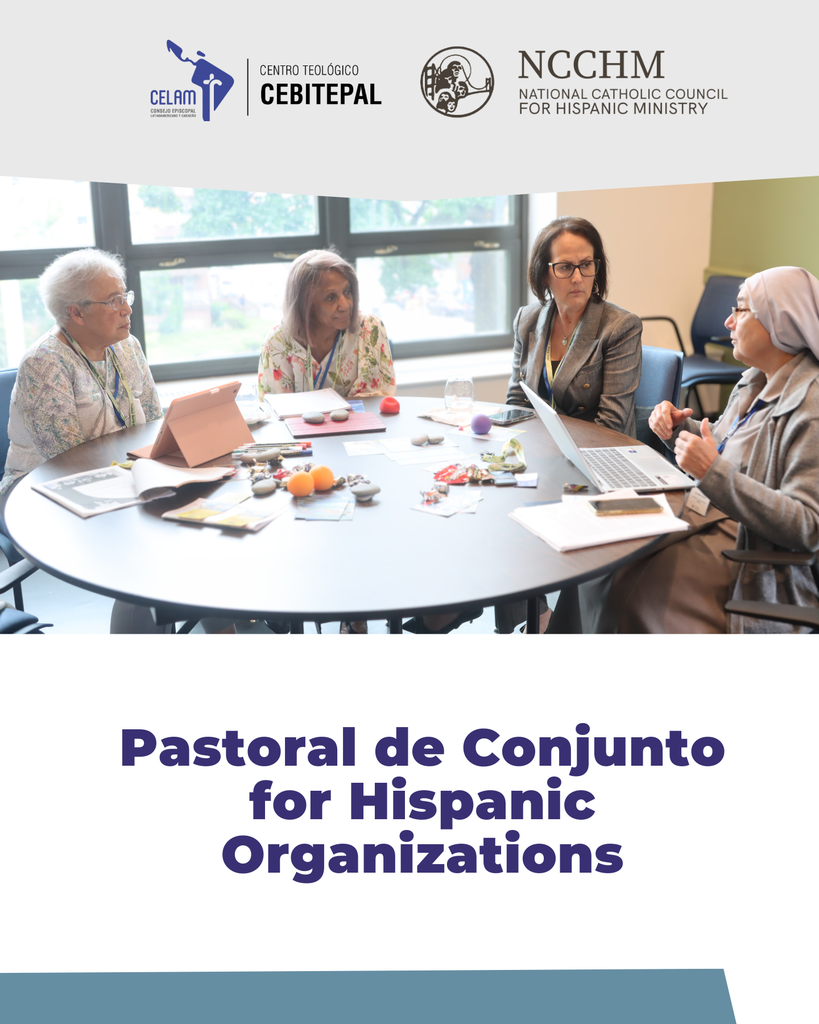
Communion in Mission for Hispanic Organizations
| Curso | Pastoral de Conjunto |
|---|---|
| Categoría | Virtuali |
This is a short video-based course in Spanish designed for organizations that work with the Hispanic community—Catholic, from other denominations, or of other types. It consists of 5 short videos, with a total duration of 50 minutes, and is completely asynchronous: each organization can complete the course at its own pace, without the need for live support.
The objective is twofold: on the one hand, to introduce organizations to the theology and practice of pastoral de conjunto, inviting them to build bridges of collaboration beyond their particular mission. On the other hand, to gather—through the participation tool at the end of the course—information about the current state of these organizations (financial situation, leadership succession, governance, generational gaps, and openness to collaboration), which will serve as input for preparing the NCCHM annual meeting.
-
📘 Informazioni sul corso5Lezioni ·
-
1️⃣ Che cos’è la Pastoral de Conjunto?2Lezioni ·
-
2️⃣ Gli Encuentros, una scuola di Pastoral de Conjunto2Lezioni ·
-
3️⃣ La realtà attuale delle nostre organizzazioni2Lezioni ·
-
4️⃣ Principi pratici di collaborazione2Lezioni ·
-
5️⃣ Riflessione, impegno e partecipazione2Lezioni ·
Lección no disponible
This is a short video-based course in Spanish designed for organizations that work with the Hispanic community—Catholic, from other denominations, or of other types. It consists of 5 short videos, with a total duration of 50 minutes, and is completely asynchronous: each organization can complete the course at its own pace, without the need for live support.
The objective is twofold: on the one hand, to introduce organizations to the theology and practice of pastoral de conjunto, inviting them to build bridges of collaboration beyond their particular mission. On the other hand, to gather—through the participation tool at the end of the course—information about the current state of these organizations (financial situation, leadership succession, governance, generational gaps, and openness to collaboration), which will serve as input for preparing the NCCHM annual meeting.